


What issue motivates people to pack a City town hall meeting on a weekday evening? Our streets, of course, and specifically, Abrams Road.
The Lakewood Branch Library auditorium filled up during the June 18 public meeting on the Abrams Road Corridor Study.
“It’s so important that our community showed out for this,” longtime neighbor Barbara Cohen said to the Lakewood/East Dallas Advocate. “I was really afraid that people were not going to show up.”
The City is collecting feedback from neighbors about issues on Abrams Road from Richmond Avenue to Beacon Street. This survey closes July 19.
There were 149 crashes (as reported by police and TxDOT) that took place between 2021 and 2025 on this mile-long stretch, which is travelled by 17,000 to 21,000 vehicles per day as well as pedestrians and cyclists in some areas, according to the City’s report, in collaboration with the firm HDR. There weren’t any fatalities, and serious injuries were few, but 24 resulted in minor injuries, and 92 involved property damage only. The number of crashes in 2025 decreased compared to the last peak in 2023 but slightly increased compared to 2024’s number.
The report documented congestion at the Richmond Avenue intersection during the afternoon peak hour starting at 4:30 p.m., sidewalk obstructions, missing or damaged curb ramps, missing push buttons for accessible pedestrian signals, bicycle lane physical barriers that had been run over by vehicles, pavement in poor condition south of Worth Street, sharp curves, and speeding.

Pragna Tata of the firm HDR gives the presentation on the new Abrams Road Corridor Study on June 18. Photo by Madelyn Edwards.
The posted speed limit is 30-35 miles per hour. On average, there’s not much speeding, but the 85th percentile speed (i.e. — “at or below which 85% of vehicles travel,” according to ITE — A Community of Transportation Professionals) goes into the 40s between Fulton and Ridgeway Streets.
According to national data collected over decades, “85% of the drivers are what we call prudent drivers,” said Auro Majumdar, assistant director within the Dallas Department of Transportation and Public Works, during the community meeting last month. “They’ll drive what they feel safe driving, doesn’t matter what speed limit you post. Depending on the road conditions, if they feel safe, they will drive at that speed. So, based on that research, what they’ve come up with is 85th percentile speed is what reasonable people feel safe driving, and that is what we use for all our traffic analysis. But there’s 15% of the people, some will be doing 60 on a 30 mph. Those are the outliers.”
He continued, “If they (the 85th percentile) are all going above the speed limit, then we have an issue, and we have to address it, and that’s what this study is showing, especially on the curves. They’re not slowing down at the curves, especially at the southern end of the corridor.”
The 85th percentile on tangent and curve speeds shows that drivers are approaching curves at 43-51 mph and staying at speeds 33-49 mph during the curves, with the higher speeds occurring south of Worth Street, according to the report.
Speed was a factor in 20% of the total crashes between 2021-25. Failing to yield for the right of way and disregarding traffic control devices made up 30% and 21%, respectively. About three-fourths of the crashes occurred at intersections, especially Beacon Street, Richmond Avenue, Prospect Avenue, Gaston Avenue and La Vista Drive. Also, about 28% of wrecks happened at night, and 35% were on angles.
“This is not like Buckner; this is not like Northwest Highway, but people treat it like that,” said Michelle Harvey, who lives near Ridgeway Street and Abrams Road. “They treat it like these six-lane highways, and it’s not.”
Six wrecks involved pedestrians, and one included a cyclist. One of these resulted in a serious injury, while the rest involved minor, possible or no injuries. Four of the crashes occurred because pedestrians failed to yield to right of way (i.e. — jaywalking), according to the report, and three took place at night, which could be indicative of lighting needs.
Residents have previously reported speeding and drivers running red lights, plus requested improved signal timing, new traffic signals, signs and markings to delineate road curves, and speed feedback signs.
“Over the past few years, my office has received concerns from residents and parents about the challenges of safely crossing Abrams to access the Lakewood Shopping Center, Whole Foods, Woodrow Wilson High School and the Lakewood Library,” District 14 City Council member Paul Ridley said at the community meeting. “We have also heard from members of the cycling community who feel that the existing bike lanes are unsafe, noting that vehicles frequently drive in them, and lanes are not clearly marked. In addition, the Dallas Police Department has been closely monitoring this roadway and reports issuing a significant number of speeding citations. Despite these enforcement efforts, we nonetheless have experienced incidents in which speeding vehicles or debris from crashes have struck nearby homes.”
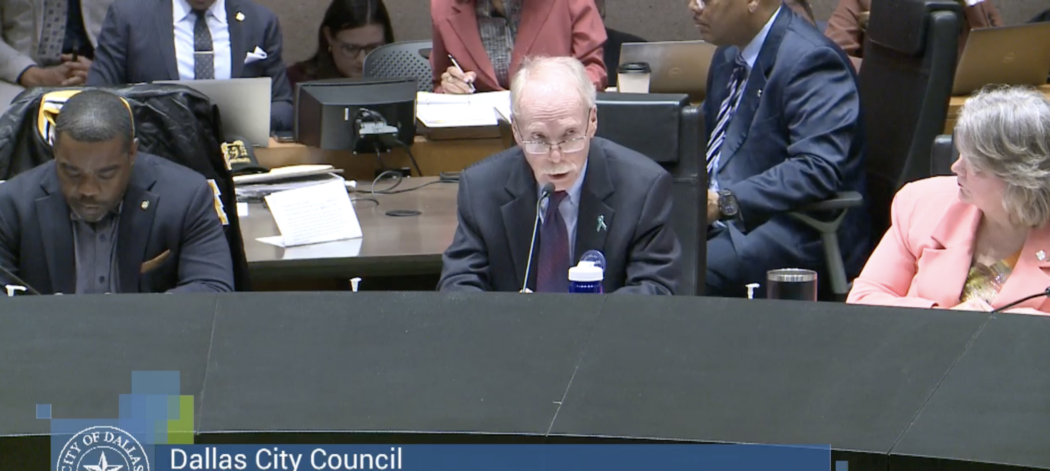
Screenshot of recorded Jan. 14 Dallas City Council meeting; District 14 Council member Paul Ridley speaks on new Abrams Road traffic safety study.
Harvey described having to stop in the middle of the road to protect children crossing the street from school.
“I physically stop my car and put my arms out in the traffic so children can cross that street on a regular basis,” she said during the meeting. “I’ve written multiple emails about this. The crossing guards I’ve physically seen almost get hit by cars coming out with stop signs.”
She also said her dog, a chihuahua named Jack, was hit and killed by a vehicle in the bike lane on Abrams a few years ago in front of her and her son. Cars did not stop even for her husband to retrieve Jack’s body from the road.
“We had to sit there and watch him get hit multiple times,” Harvey said during the meeting. “I just beg you, please, there are people that live on that street, and what can we do to get the speed down?”
The audience applauded her after she finished speaking.
Harvey has lived in her home since before the COVID-19 pandemic, and she said traffic issues weren’t that bad then but have progressively gotten worse as the neighborhood has grown. She has also noticed that drivers, including the likes of semi tractor trailers and cement mixers, will use Abrams Road to get to Downtown.
“Those trucks need to be not on that road,” she said to the Advocate. “They can go down Garland Road; they don’t need to come down this residential road at those kinds of speeds because they can’t stop fast enough.”
Cohen also said East Dallas streets are used for drivers avoiding highways, but there are nuances to that conversation.
“I understand that people are trying to get home. I get it. I take Abrams; I take Skillman; I take Gaston; I take Garland; we all take these roads,” she said. “It’s a bigger problem, isn’t it? Like, why are people so aggressive? Why are people driving this way? But I really think that it is a cut through. You can skip I-30, and you can cut through our neighborhood. We do it because we live here. So that’s one of those things — can we do it and you can’t? That’s not right. That’s going to make people angry. You can’t say that.”
Even safety measures that have been added aren’t enough, Harvey said, like the crosswalk with flashing lights that is ignored by drivers. After talking with transportation officials, she thinks having a red light instead of a yellow one, like the beacons on Northaven Trail, may be better.
“It’s not like yellow, caution, slow down,” Harvey said. “It’s like red, you need to stop.”
She also said drivers don’t slow down for the school zone in her neighborhood either.
“When there’s not a police officer present, they just drive as fast as they want to through that area,” Harvey said. “I’ve even seen them honk at people that are slowing down in the school zone … or speed around them because they think they’re in the way.”
Installing speed humps, like the ones on La Vista Drive, could also help, she said.
Cohen said during the meeting that the bike lanes were made too wide, and motorists will use them as passing lanes.
“People drive so fast. The cops are in front of my house every day. They cannot even pull over all the people speeding,” Cohen said during the meeting.

Bike lanes on Abrams Road between Beacon and Ridgeway streets. Photo courtesy of Bike DFW.
Ridley told the audience that more town halls are to come in the future for this study that is made possible through District 14 discretionary bond funds.
“Previously, we had studied the section between Richmond and Northwest Highway,” Majumdar said during the meeting. “That study actually recommended a lot of improvements. We didn’t have money for all of them, but we are actually getting funds to build some of those recommendations. What this study will do is also something similar.”
Other recent and upcoming projects include:
- Study Abrams Road between Gaston and Richmond Avenues
- Study Beacon Street/Graham Avenue between Columbia Avenue/Abrams Road and Samuell Boulevard/Winslow Avenue
- Study Gaston Avenue between Washington Avenue and Garland Road/Grand Avenue
- Columbia Avenue/Main Street Complete Streets project from Beacon Street to Exposition Avenue
- Traffic signals under design – La Vista Drive, Richmond Avenue
- Reconstruction of signals at Gaston Avenue, Beacon Street
- Complete Streets project on La Vista Drive from Paulus Avenue to Gaston Avenue
- Multiple street maintenance projects, including on Glasgow Drive, Victor Street, Paulus Avenue, Tremont Street, Ridgeway Street, Worth Street, Belmont Avenue and Goliad Avenue
Once the feedback has been collected and a safety analysis has been conducted, the City officials and collaborators will put forth recommendations for the short term (in five years), mid term (five to 10 years) and long term (more than 10 years). Then, they will get more feedback on recommendations and work with the City Council on getting funding.
Cohen has seen these issues being discussed before, but she’s optimistic.
“I believe in the power of people, and I believe that dedicated people working together, I think we can make changes,” she said. “I think we can. I haven’t given up yet.”

