


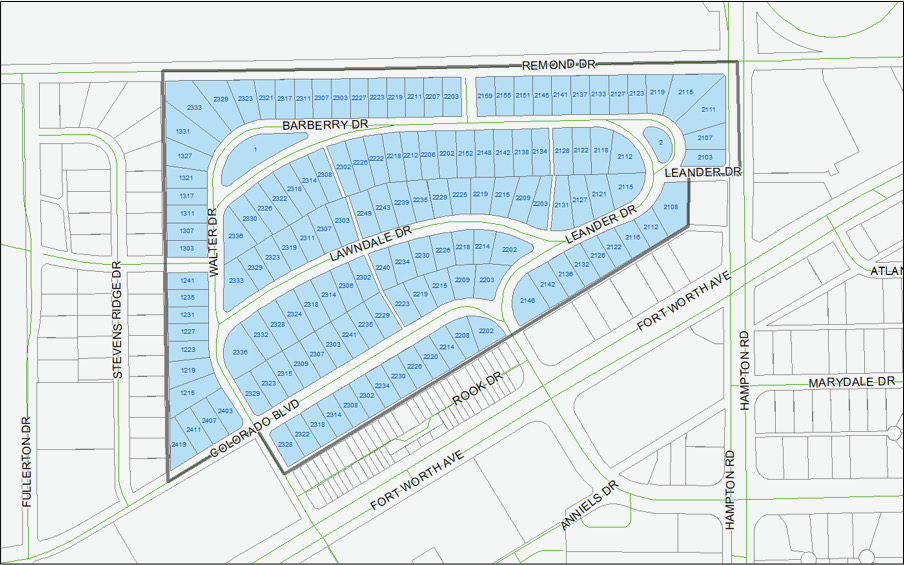
Stevens Park Village proposed conservation district boundaries. Courtesy of Dallas Planning and Urban Design.
Stevens Park Village is officially a conservation district following a unanimous vote from the city council on Wednesday.
As a conservation district, base zoning is replaced with zoning tailored specifically to the neighborhood to promote development or redevelopment that is compatible with the existing character. The neighborhood determined what those zoning categorizations are, with standards set for the Stevens Park Village Conservation District to have regulated building height, permitted uses (stories), setbacks and architectural styles.
The effort to become a conservation district began with 11 neighbors in May 2022. The Stevens Park Village Conservation District is generally located within the boundaries of Remond Drive to the north, Hampton Road to the east, the alley located west of Walter Drive between City Blocks 7/4809 and 5/4808 with City Blocks 1/6166 and 3/6166 on the west, a portion of West Colorado Boulevard between City Blocks 7/4809 and 1/6167 along with the alley located south of West Colorado Boulevard splitting City Block 6/4726 and a portion of City Block 1/4724 to the south.
Of the 141 homes in Stevens Park Village, a majority were built in the 1940s, with 130 homes in the Minimal Traditional style.
The city verified signatures from 76% of properties within the proposed boundary. There were 239 notices sent out to property owners within or surrounding the proposed conservation district. Of the 117 responses received, 86 were in favor and 36 opposed.
In March 2025, the city accepted the signed petitions with the City Plan Commission approving the request unanimously on May 21, 2026 with an amendment to remove the non-rental requirement in the Additional Dwelling Unit (ADU) definition.
David Preziosi, Stevens Park Village resident and member of the neighborhood committee, said at the council meeting that there were 15 public meetings held with 71 brochures, emails and handouts distributed to keep the neighborhood informed throughout the process and to gather input.
“This ordinance does a great job of threading the needle between protecting the existing character of the neighborhood, while allowing sensitive changes to occur,” Preziosi said Wednesday night. “It allows expansion of existing houses, or new construction as compatible with the existing houses in the neighborhood.”
This approval marks the ninth conservation district in Oak Cliff, following the addition of South Winnetka Heights in 2024. The next three neighborhoods in the process to become conservation districts include Kidd Springs, Wynnewood North and Hampton Hills, all also within District 1 of Oak Cliff.

