


As you drive, walk and bike the streets of Lake Highlands, you’ve probably wondered at one time or another where the street names come from. Some of this has been discussed in past issues of the Advocate, like Audelia Road.
Audelia’s named for the tiny community that once existed at the intersection of Forest and Audelia, just north of what is now Lyndon B. Johnson Freeway, aka US Interstate 635. The village was in turn named for Ardelia Ellen Jackson West, whose husband and father built and operated a general store and post office for about 50 years.
The L Streets have also received their due. Bounded roughly by Walnut Hill Lane, Plano Road, Ferndale Road, and Northwest Highway, all but a few in this area begin with the letter “L.” The origin remains a mystery.
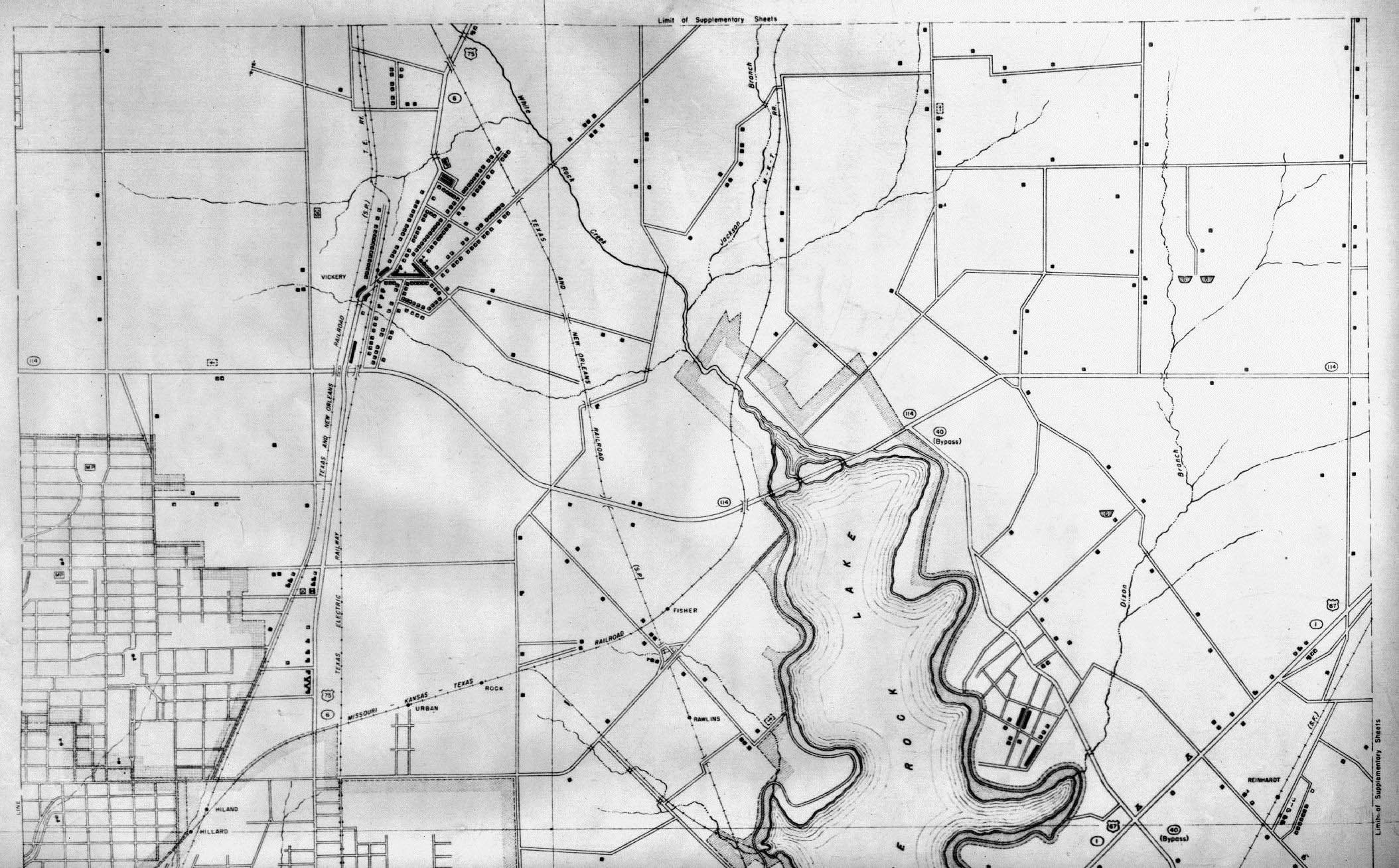
This map showing the Lake Highlands area in 1936 shows that there were few roads then, most of them simple country lanes. Some of them, like Audelia, were previously wagon trails and possibly Indian traces earlier. State Highway 114, which is now Northwest Highway/Loop 12, cuts through the northern end of White Rock Lake as it does today. The only developed area is Vickery, which has US Route 75 (Central Expressway) running through it. Greenville Avenue splits off in Vickery at a nearly 45-degree angle. Abrams, Skillman, and Audelia are the three roads cutting through White Rock Creek and Jackson Branch Creek. Map courtesy of Dallas Municipal Archives.
Skillman, named for banker and civic leader William F. Skillman, was renamed from Lindbergh – as in Charles Lindbergh, the pioneering transatlantic aviator. Lindbergh’s name was stripped by the Dallas City Council in 1941 for his comments that supported Adolf Hitler and antisemitism.
A stretch of Abrams was once called Greenville Road and was changed in the 1930s, possibly to avoid confusion with Greenville Avenue. It’s named for Harold Abrams, railroad executive, civic leader and a founder of the Dallas Symphony Orchestra.
Streets that utilize parts of Lake Highlands in the name – Lakeland, Royal Highlands, Lakemere – all derive their name from the original Lake Highlands additions, developed in the late 1920s-1930s by Henry Wilbur Brouse.
For that matter, folks might like to know the connection between the Vickery neighborhood and Lake Highlands. H. W. Brouse’s wife, Allie Vickery Brouse, was the daughter of Richard Vickery of Waxahachie and Fort Worth. “R. Vickery” and colleagues in the Works-Coleman Land Company developed a number of subdivisions in Dallas and Fort Worth.
The pioneering Goforth family are connected to two streets in Lake Highlands: Goforth Road and Church Road. The family once owned a large swath of the property reaching from Northwest Highway to Garland Road, much of it purchased by the City of Dallas to create White Rock Lake. Church Road is named for Samuel Churchwell Goforth — called Church – a prominent cotton farmer and cattleraiser who lived on what’s now Flagpole Hill until 1911.
Another pioneer, J. B. Merriman, is the namesake of Merriman Park Addition and Merriman Parkway. He came to Dallas County from Virginia in 1880. His farm and home were on Abrams Road at White Rock Creek, which is now inside Merriman Park Addition.

