


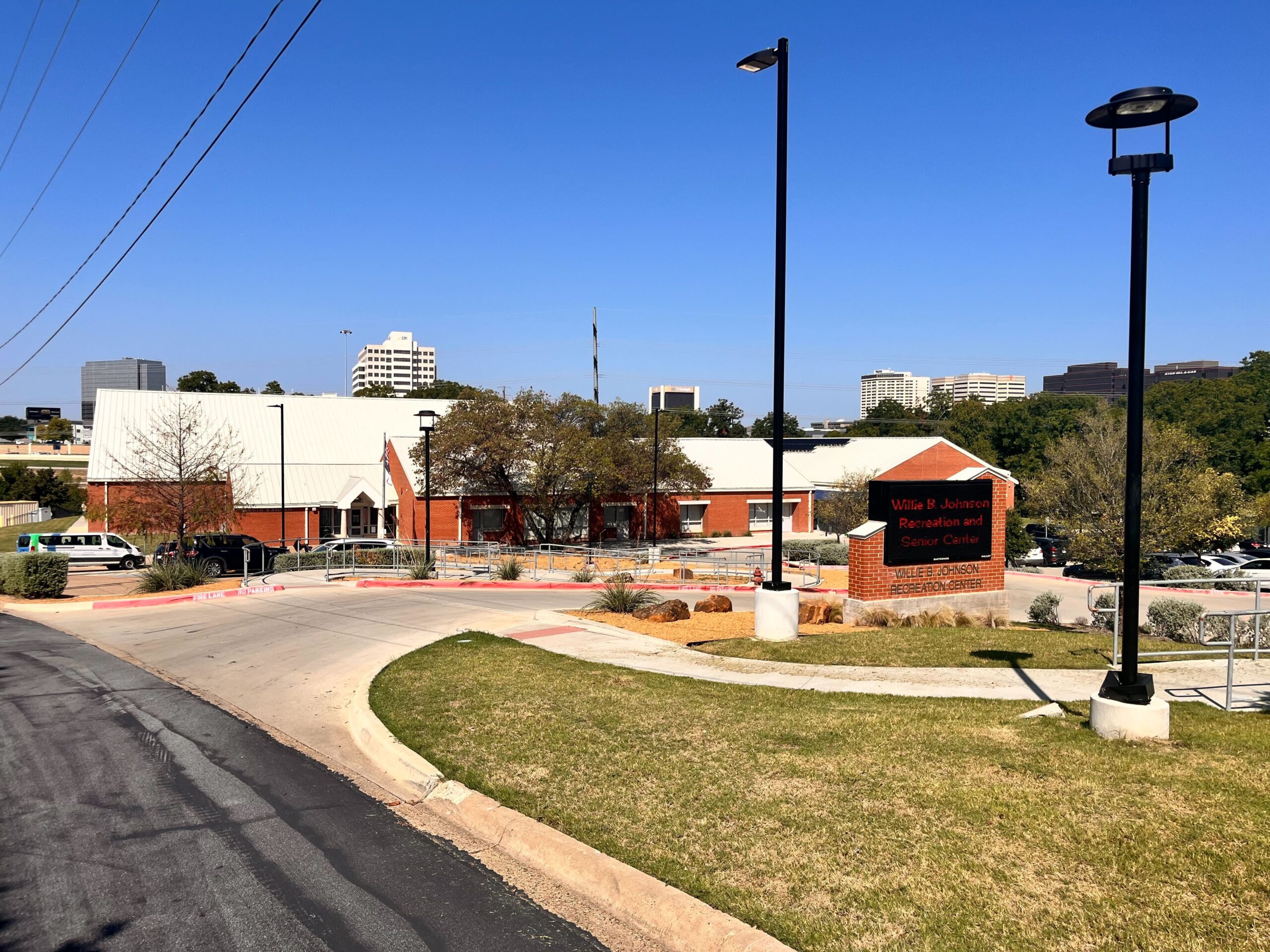
District 10 council member Kathy Stewart hosted a budget town hall Tuesday, Aug. 25, at the Willie B. Johnson Recreation Center, where residents questioned city officials about the proposed 2026-27 budget, Dallas Water Utilities charges and the future of City Hall.
With an estimated $5.66 billion budget for the upcoming fiscal year, many questions during the 90-minute meeting focused on transparency and how city funds are being allocated.
Brian Thompson, interim director of Facilities Management, answered a question regarding the $500,000 cut from the building repairs budget.
“If you’re looking at the budget documents, you will see a reduction in the facilities and real estate management budget,” Thompson said. “Part of that reason is in fiscal year ’27 we will be separating the real estate function from the facilities management function.”
Thompson said roughly $3.4 million of the City’s combined budget will be transferred to the Office of Real Estate. He referred to this as “one piece of the reduction in the budget development process for fiscal year ’27.”
“I’ve been advocating for several years to better maintain and hopefully avoid critical failures across our buildings,” Thompson said. “On paper it looks like there’s a reduction but my overall operating budget really has not fluctuated a lot.”
According to Thompson, the Facilities Management budget includes $4.1 million for general maintenance and $3 million for preventative maintenance.
Another major concern during the meeting was the service charge Dallas residents have seen when paying their Dallas Water Utilities bills.
“Just for clarification, one of the things that we did when we were going to budget was really looking at where we are receiving price increases,” said Sally Wright, deputy director of Dallas Water Services “One of the areas we were seeing is that we were spending over $7 million in processing fees, and that was for people who chose to use cards.”
Wright explained that the money collected through processing fees does not return to Dallas Water Utilities. Instead, the money goes directly to the processing company.
Assistant City Manager Dev Rastogi explained that when the service charges were “relatively minor,” DWU was able to absorb the costs. Currently, the department cannot.
“We have to calculate the rates that are charged by those water utilities based on the costs,” Rastogi said. “But when [the charges] started to get up to the level that it is, we really couldn’t [absorb] that.”
The conversation then shifted to the future of Dallas City Hall, as the city continues to consider options for replacing or repairing the building.
One question that prompted a back-and-forth between an attendee and Janette Weedon, deputy director of Budget and Management Services, asked whether the City’s potential lease-purchase of one or more buildings to replace City Hall could be financed through non-voted certificates of participation and whether the cost would be paid through debt service or the general fund.
“The decision regarding City Hall has not been finalized, and historically, we have used our certificates of obligation debt to fund road projects, primarily street-related work,” Weedon said. “So, I have not heard any conversations about using either certificates of obligation or certificates of participation.”
City representatives were also questioned about why the City Council could not take a pay cut to help address furloughed employees and library closures.
Rastogi explained that the city manager’s recommended budget did not include any changes to City Council compensation. She further reiterated that town hall budget meetings are part of the process of listening to the community.
As the meeting’s allotted time came to an end, Stewart addressed questions about the next steps for City Hall.
“My approach to City Hall has been to look at the numbers because I believe my job is to be a good steward of taxpayer dollars,” Stewart said.
She explained that the City has had three groups examine the needed repairs for City Hall. According to Stewart, the first group estimated repairs would cost about $327 million. The second group estimated the cost at between $500 million and $600 million. The last group to review the repairs, according to Stewart, was the only one who did a thorough investigation. No estimate from that review was mentioned during the meeting.
Although Stewart said “no final decision has been made,” she reiterated that her final decision is a “numbers decision.” However, she explained what a potential relocation would need to look like for her to support it.
“The only move that I would support would be into an office building with a high percentage vacancy that is in the center of Dallas,” she said. “That’s where I would go. That’s where I think our city needs — I don’t know — 1,500, 2,000 employees to buy coffee every morning and go get lunch and just help that part of our city.”

