


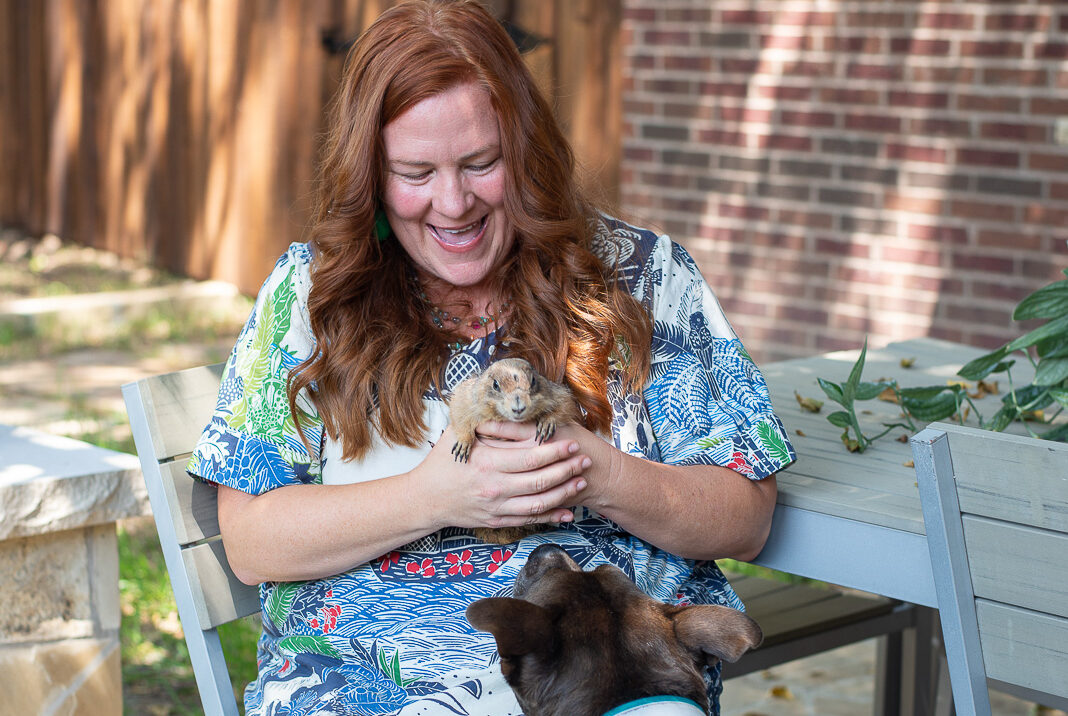
Shelby Bobosky, East Dallas neighbor and longtime animal advocate, has started a new nonprofit.
Bobosky’s background is in law, (she also teaches at the Southern Methodist University Dedman School of Law), but she pivoted to animal advocacy years ago. She joined the Texas Humane Legislation Network board and then served as the organization’s executive director. As she exited the network earlier this year, she realized her work wasn’t done yet.
“Two days after an announcement was made, my phone kept ringing, and I kept getting calls from people,” Bobosky said. “‘Help me with this ordinance.’ ‘What do I do? I suspect dog fighting.’ ‘I’m fighting with my neighbor. What is the law on nuisance issues surrounding pets in Harris County?’ I thought, you know what, I’m not done yet. And there is so much need for animal policy at the state level, at the local level and realized that this is meant to be, and given my background and the institutional knowledge I have, I couldn’t pass it up.”
Enter Lone Star Humane Association, which aims to help pass animal welfare laws at the local and state levels in Texas.
Bobosky said Lone Star is classified under Internal Revenue Code Section 501(c)(4) as opposed to Section 501(c)(3). This means that donations are not deductible on federal income taxes, but the scope of what 501(c)(4)s can advocate and lobby for is unlimited.
“(C)(4) organizations do not have grant money readily available because we advocate, and we lobby,” she said. “But in the animal world right now, we cannot rescue our way out of this sheltering crisis. We have an overpopulation crisis of dogs and cats that is existential, and it’s continuous, and it’s exhausting. So we need to go and look at the policies that we put forth to determine if that is the best for Texas. There’s a lot of groups that come in that have a lot of funding, and they have agendas, but sometimes those agendas don’t work for us here in Texas.”
Bobosky’s nonprofit has goals nationally and locally. In one day last month, she traveled to Washington D.C. to ask Sen. Ted Cruz’s office for support on the Save America’s Forgotten Equines (SAFE) Act and was back in town by the evening to train people how to effectively advocate for Dallas Animal Services at Samuell Grand Recreation Center. She is supportive of DAS and wants animal control officers to be classified as first responders in the future.
“These are extraordinary times to be in animal sheltering, and the individuals that work there have some of the most extraordinary jobs,” Bobosky said. “Imagine caring for an animal that you may have to euthanize. Nobody else has that kind of job, and they might also be paid the same working at Tom Thumb, checking out groceries. They could be bit by a dog or a cat. They could be harassed by local individuals that don’t think we should euthanize any animal. So I support them in every single way I can.”
She also plans to advocate for strengthening the dogfighting and cockfighting law in Texas next year. In addition to causing violence against animals, illegal drugs and weapons are also usually found in fighting operations, according to a 2021 article on the FBI’s Law Enforcement Bulletin website. This issue is personal to Bobosky, whose pet Fern was rescued from a dogfighting operation.
“I hope when I advocate for this law that I tell elected officials her unbelievable story,” she said. “During COVID, I was walking her, and a 10-year-old boy was walking by, and he goes, ‘Your dog is ugly.’ … I turned around and went back to him, ‘Do you know why she looks that way?’ And he was interested, and I said, ‘Because she was forced to fight, and those missing pieces on her head, that’s actually skin that was ripped off in those fights. So she might not look the way that other dogs look, but she’s one of the strongest, most amazing dogs I know because she’s a survivor.’ He said, ‘Oh, thanks, lady,’ and walked on.”
Other legislation to support includes that related to veterinary telemedicine and removing a requirement of having to establish a relationship with a vet through an in-person appointment first. Bobosky said this could help many pets in Texas by connecting owners with reliable care as opposed to turning to internet advice.
“I want to leave people with this idea that we can get political for animals,” she said. “Getting political is kind of a scary word, idea, message, but animal issues are bipartisan. If it is a common sense bill or law or statute, then everybody can get on board.”
You can find Lone Star Humane Association on Facebook and Instagram.

