


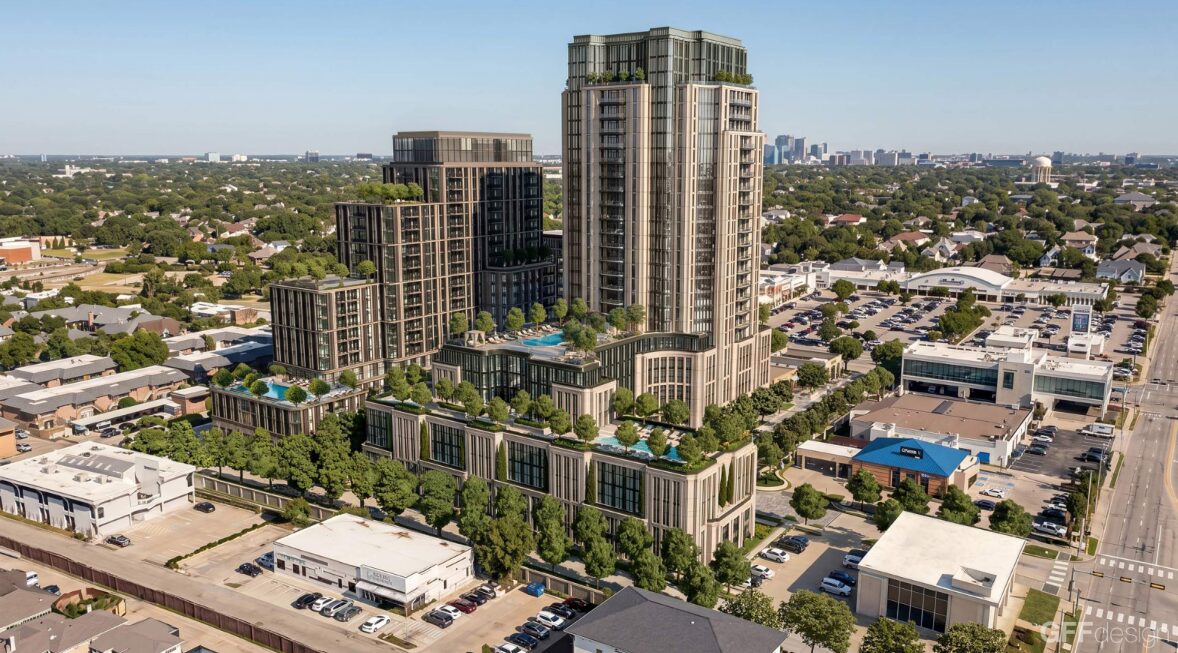
Screenshot from Preston Royal Zoning Case Neighborhood Meeting.
Dallas City Council voted 9-6 on Nov. 10 to approve the proposed Preston Royal development at Preston Road and Royal Lane.
The decision followed more than five hours of debate among supporters and opponents of the $800 million project, which would redevelop the southwest corner of the intersection.
District 13 Council member Gay Donnell Willis moved to approve the development with additional conditions through an amendment to the zoning proposal.
Willis’ amendment establishes a maximum building height of up to 199 feet (17 stories) for portions of the development that meet mixed-income housing conditions. It also restricts certain commercial uses, establishes minimum parking requirements based on building use and requires developer-funded traffic improvements.
Her recommendations differed from developer Leland Burk’s original plans for the site. Burke along with partner Gerald Stool’s Greenway Investment Co., originally had plans to build the hotel and condominium tower at 325 feet (28 stories) and the apartment high-rise at 275 feet (24 stories).
Among the required traffic improvements proposed in Willis’ amendment are a new emergency vehicle signal at the entrance to the Dallas Fire-Rescue Station No. 41 on Royal Lane and upgrades to the existing traffic signal at Preston Road and Royal Lane.
Willis said the developer must also fund a traffic signal timing study along Royal Lane between Midway Road and Hillcrest Road and portions of Preston Road. All improvements must be approved by the City’s Department of Transportation and Public Works.
In explaining her support for the development, Willis pointed to changes made to the project following neighborhood feedback and meetings with the developer and Preserve Preston Hollow, a neighborhood advocacy organization.
“Through all of this input, the height of this project has been reduced by almost 40 percent,” Willis said. “This includes another meaningful reduction of 41 feet, just in the last couple of days.”
She also highlighted $5.2 million in infrastructure improvements, including sewer and water upgrades, as well as traffic signal improvements. The project is also expected to add more than 150 trees and contribute nearly $6 million to the City’s affordable housing fee-in-lieu fund.
Willis said the development could generate more than $13 million in annual tax revenue for the City and $30 million annually for Dallas ISD and other taxing entities.
Roth proposes lower building heights
District 11 Council member William Roth proposed a separate amendment that would have imposed lower building-height limits across the development.
Under Roth’s proposal, buildings in height zone one would have been limited to 54 feet, with a maximum of 59.4 feet if the development met mixed-income housing conditions. Height zone two would have been capped at 75 feet, or 82.5 feet with the housing conditions, while height zone three would have been limited to 110 feet, or 121 feet with the conditions.
“I would [also] request one off-street parking space per every 300 square feet of gross building floor,” Roth said. “That would be required, irrespective of the types of uses that would be presented there.”
Roth said the proposed zoning conditions were inadequate and the timing to approve those conditions was haste.
“This is a complicated situation. We’re talking about a planned development that’s got a lot of unclear issues that are not specified,” Roth said. “The fact that we’re asking and we’re doing the committee work here publicly is wrong.”
Roth’s amendment and motion failed.
Residents offering different views
Not all nearby residents opposed the development.
Ann Johnson, who lives about half a mile south of the project, spoke in favor of the development, saying she believed it would benefit Dallas through additional housing, tax revenue and contributions to the City’s affordable housing fund.
“I live in a 1950s-era, midcentury modern, one of the few left in the neighborhood,” Johnson said. “This is progress in a neighborhood where nothing looks like it did in the 1950s. I don’t know why we would cling to 1950s-era zoning restrictions.”
She also pointed to the project’s location at the intersection of a state highway and a six-lane thoroughfare as an appropriate place for additional density.
Other residents urged the council to reject the development, arguing that its proposed height and scale did not reflect the surrounding neighborhood.
Matt Bock, a Preston Hollow resident, said more than 5,000 residents opposed the redevelopment proposal. Bock referenced the 5,315 signatures and 175 letters against the development Preserve Preston Hollow delivered to City Hall on Nov. 9.
Bock said the project did not reflect the wishes of nearby residents and compared the zoning case to the previously debated Pepper Square redevelopment.
“Residents aren’t objecting to change. They’re objecting to being asked to accept decisions about their own neighborhood that ignore their input and wishes,” Bock said. “Preston Hollow residents are asking that any change be justified on its merits and at a scale that actually fits the neighborhood.”
What happens next?
The council’s approval comes as opposition to the development continues.
Preserve Preston Hollow has hired Dallas attorney Austin Smith, who previously represented residents who sued the City of Dallas and developers over the rezoning of Pepper Square.
The Preston Hollow Advocate has reached out to Preserve Preston Hollow for comment on its plan moving forward.

